
Government Plans to Add 1 Lakh Allied Health Professionals to Strengthen Healthcare Workforce
A post-Budget webinar discussed strategies to expand allied healthcare education and build a larger skilled workforce to support India’s growing healthcare needs
- By PharmaNews Live Desk
- New Delhi
- Mar 09, 2026
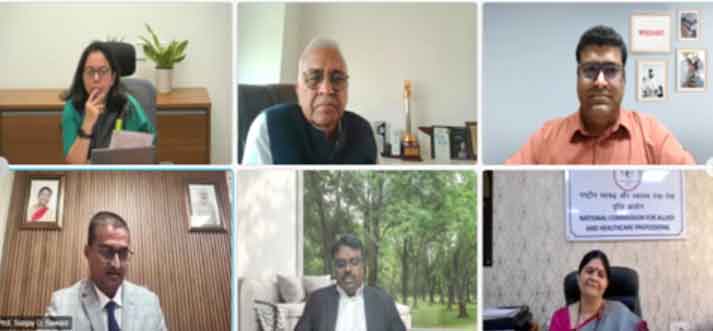
The Government of India is working to expand the country’s allied healthcare workforce, with plans to add 100,000 allied health professionals over the next five years, according to discussions held during a post-Budget webinar on March 9.
The breakout session, organised by the Ministry of Health and Family Welfare as part of the post-Budget webinar series themed “Sabka Saath, Sabka Vikas – Fulfilling Aspirations of People,” brought together policymakers, regulators, industry representatives and academic experts to deliberate on strategies for scaling up allied healthcare education.
The initiative aligns with the broader objective of improving the accessibility, quality and sustainability of allied healthcare services across the country.
Rising demand for skilled allied healthcare professionals
The session was moderated by Dr. Vinod Kotwal, Additional Secretary, Ministry of Health and Family Welfare, who highlighted the growing demand for trained allied health professionals in India.
She noted that demographic changes, the rising burden of non-communicable diseases, the expansion of healthcare infrastructure and the rapid adoption of advanced medical technologies are driving the need for a larger skilled workforce in allied healthcare fields.
According to Kotwal, sectors such as diagnostics, imaging, physiotherapy, emergency care and anaesthesia technology are witnessing increasing demand for qualified professionals.
Focus on expanding education and training capacity
The government initiative aims to expand training capacity across diploma, undergraduate and postgraduate programmes in allied health disciplines. The plan also includes modernising government institutions, strengthening laboratories and simulation facilities, addressing faculty shortages and promoting awareness among young people about career opportunities in the sector.
Priority disciplines identified for expansion include optometry, physiotherapy, medical laboratory sciences, dialysis therapy, radiology and imaging technology, radiotherapy technology, anaesthesia and operation theatre technology, emergency medical technology, occupational therapy and behavioural health.
Officials also highlighted the need to maintain uniform standards across institutions under the regulatory framework established by the National Commission for Allied and Healthcare Professions (NCAHP) under the National Commission for Allied and Healthcare Professions Act, 2021.
Expanding institutional capacity across the country
India currently has over 500 government institutes offering around 48,000 seats, while about 3,800 private institutes provide more than 3.6 lakh seats in allied health education programmes.
Participants in the discussion emphasised the importance of strengthening existing medical colleges so that they evolve into comprehensive ecosystems supporting both medical education and allied health training.
They also suggested leveraging district medical colleges and hospitals as training hubs for allied health sciences in order to significantly expand the country’s training capacity.
Collaboration between academia, hospitals and industry
The panel discussions highlighted the importance of collaboration between academia, healthcare providers and industry to develop a skilled allied healthcare workforce. Participants also suggested strengthening faculty exchange programmes between universities and medical colleges to address faculty shortages and improve the quality of teaching and training.
The webinar concluded that expanding allied healthcare education and professional capacity will be essential for supporting India’s evolving healthcare system and meeting both current and future demands for healthcare services.